


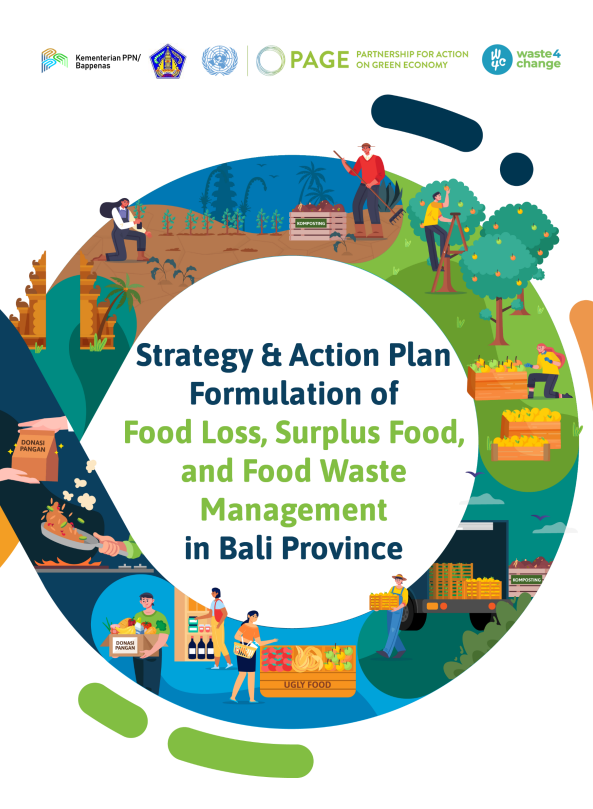
Report Strategy and Action Plan of Food Loss, Surplus Food, and Food Waste Management in Bali Province (Available in English and Bahasa Indonesia)
The "Strategy & Action Plan for Food Loss, Surplus Food, and Food Waste Management in Bali Province" report is a collaborative effort led by the Ministry of National Development Planning/Bappenas, in partnership with UN-PAGE and Waste4Change. The study highlights that Bali generates 201.08 kg of food loss and waste per capita annually, exceeding the national average. Major contributors to food loss include production and consumption stages, particularly in fruit, grain, and vegetable commodities. The report identifies key challenges such as inadequate infrastructure, poor food management practices, limited awareness, and weak policy enforcement. The study utilizes both qualitative and quantitative methodologies, including stakeholder consultations, data analysis, and impact projections, to develop a strategic framework for addressing food loss and waste.
To mitigate the issue, the report outlines seven strategic recommendations with 18 action plans, aligned with Indonesia's national goal of reducing food loss and surplus food by 50% by 2030 and 75% by 2045. These strategies focus on regulatory reinforcement, funding optimization, capacity building, infrastructure improvements, data integration, research development, and incentive implementation. Additionally, the report emphasizes the environmental, economic, and social impacts of food loss, including greenhouse gas emissions, economic losses of IDR 6–10 trillion annually, and nutritional deficiencies from discarded surplus food. The proposed measures aim to support Bali’s sustainable development agenda and integrate food waste management into regional policies, including the Bali Low Carbon Development Plan and Circular Economy Roadmap.
For a deep understanding, please download and read document below. This report is available in both English and Bahasa Indonesia.
English Version
Bahasa Indonesia Version