




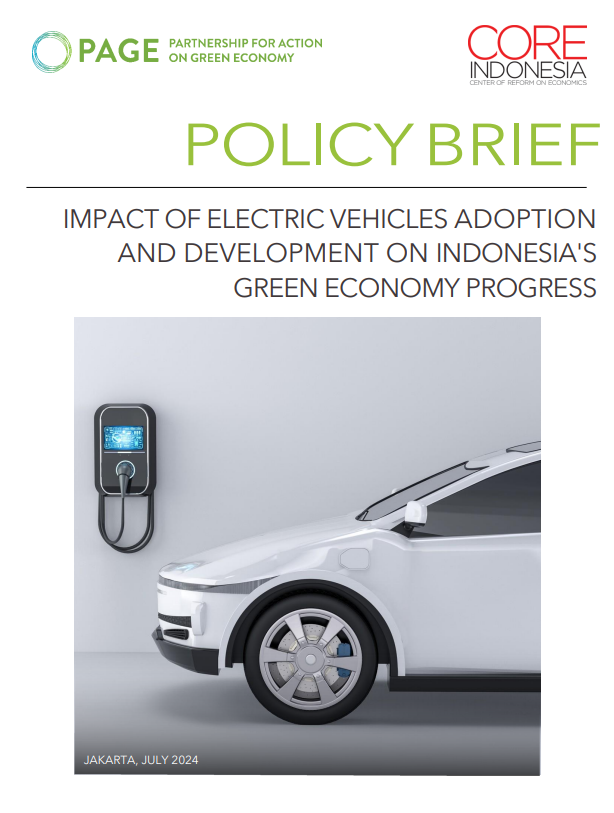
Policy Brief: Impact of Electric Vehicles Adoption and Development on Indonesia's Green Economy Progress (Available in English Only)
The policy brief explores the impact of electric vehicle (EV) adoption on Indonesia's green economy, emphasizing economic growth, environmental sustainability, and social well-being. Using the Indonesia Green Economy Index (IGEI) and the Green Economy Model (GEM), the study evaluates three scenarios: Business as Usual (BaU), Low Carbon Development Initiative (LCDI) with Net Zero Emissions (NZE), and EV Impact. Findings suggest that prioritizing domestic EV manufacturing could boost GDP by up to 7% by 2060, while reliance on imports may lower GDP. Although transitioning to EVs may disrupt traditional automotive jobs, it can generate employment in new industries, necessitating reskilling programs. EV adoption is also a crucial tool for reducing greenhouse gas emissions, but its effectiveness depends on a concurrent shift to renewable energy sources.
To accelerate EV adoption, the brief recommends financial incentives such as subsidies, tax credits, and public-private partnerships, alongside policies promoting local EV production and charging infrastructure. Government support should extend to industry development, including incentives for domestic battery and car manufacturing, workforce reskilling, and regulatory measures that promote a sustainable energy transition. The study underscores that while EV adoption enhances Indonesia's Green Economy Index, broader sectoral policies in forestry, land use, energy, and waste management remain critical in achieving long-term sustainability goals. Strengthening EV policies and integrating them into Indonesia’s green economic strategy will be essential for maximizing environmental and economic benefits.
For more detail about the policy brief, please donwload and read the document below (available in English only).
Download