



Advancing Indonesia’s Circular Economy: Insights from the Validation Workshop on Electronics and Construction Sectors
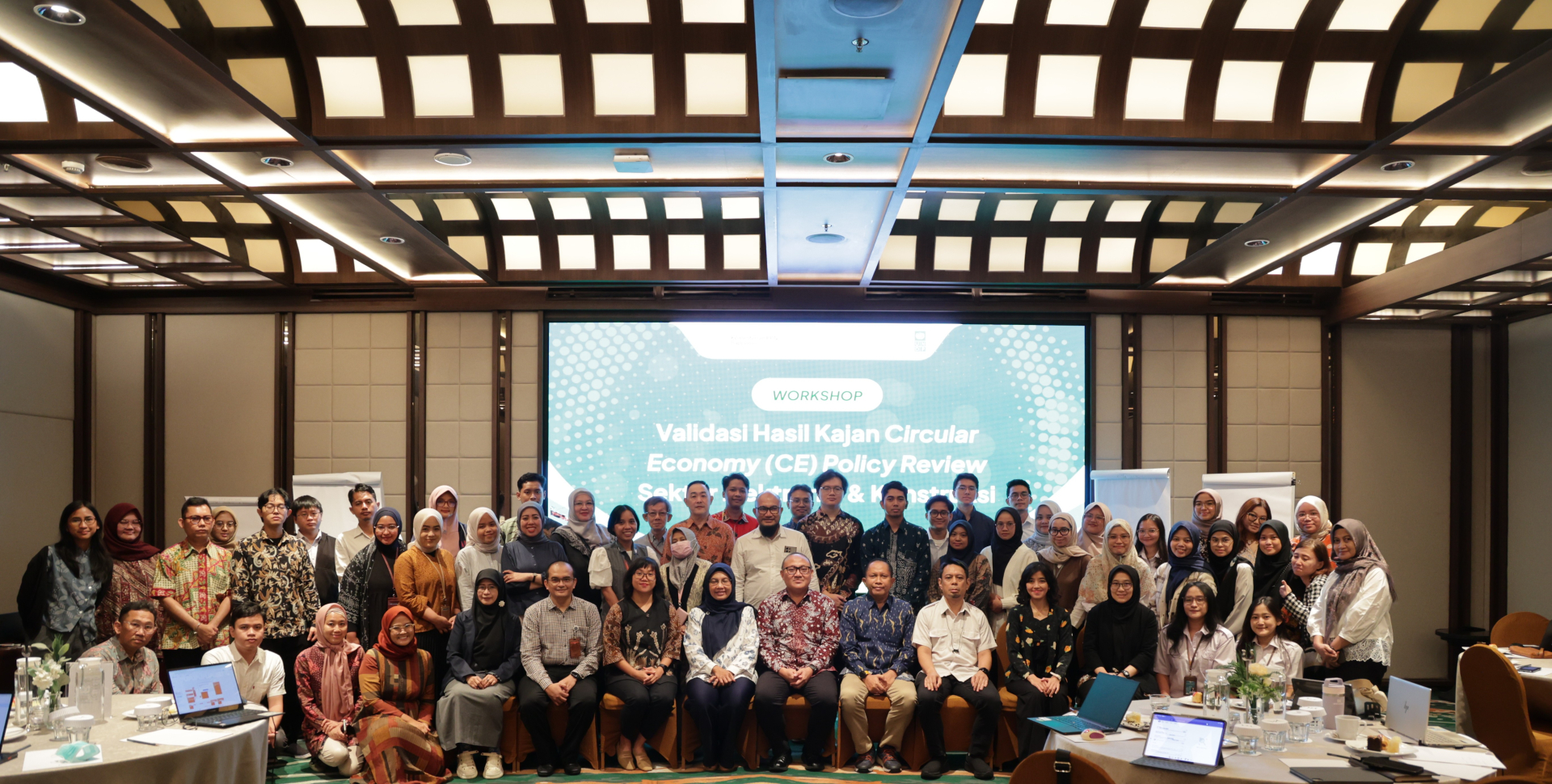
On 6 April 2026, PAGE Indonesia, led by UNDP Indonesia, in close collaboration with the Ministry of National Development Planning/Bappenas, convened a validation workshop to advance the policy review on circular economy (CE) in the electronics and construction sectors. The workshop brought together key stakeholders from government, development partners, associations, and industry to reflect on findings, validate policy directions, and, most importantly, align on practical pathways to accelerate implementation. The discussion comes at a critical time. Indonesia has already embedded the circular economy into its national development agenda, including the RPJPN 2025–2045 and RPJMN 2025–2029. Yet, as emphasized throughout the workshop, the challenge now lies in translating ambition into action.
Director of Environmental Affairs at Bappenas, Nizhar Marizi, highlighted the urgency of this transition by pointing to the scale of the challenge. The construction sector alone accounts for a significant share of global energy demand and emissions, while electronic waste continues to grow rapidly with limited formal management. He stressed that a circular economy offers a systemic solution—one that moves beyond waste management to redesign how resources are produced, used, and recovered across the entire value chain.
"A circular economy is not only about reducing waste but about rethinking the entire system—from upstream design to downstream recovery—so that materials can continuously create value,” he noted during the session.
This systemic perspective resonated strongly across discussions. Participants acknowledged that while Indonesia has a relatively comprehensive regulatory framework, implementation remains fragmented. Policies often operate in silos, data systems are not yet fully integrated, and market incentives for circular practices remain limited. As a result, the circular economy is still frequently treated as a compliance issue, rather than as an economic opportunity.
From the perspective of UNDP Indonesia, bridging this gap requires stronger alignment between policy, financing, and market mechanisms. Nila Murti, Head of the Financing for Development and Inclusive Growth Cluster, emphasized that a circular economy must be positioned as an attractive investment proposition.
"A circular economy should not be seen only as an environmental obligation, but as an opportunity to mobilize investment and drive sustainable growth. Strengthening the link between circularity and financing will be key to accelerating implementation,” she highlighted
Sector-specific discussions further illustrated both the opportunities and constraints. In the electronics sector, the absence of a dedicated Extended Producer Responsibility (EPR) system, combined with limited data on e-waste flows, continues to hinder progress. Meanwhile, the industry structure—still dominated by distribution rather than manufacturing—adds complexity to efforts in embedding circular design and lifecycle approaches.
In the construction sector, the challenge is less about the absence of regulations and more about their implementation. While policies related to green construction, waste management, and procurement already exist, they are often voluntary, unevenly enforced, and not yet fully integrated across the project lifecycle. In practice, sustainability considerations are frequently overshadowed by cost-based decision-making, particularly in public procurement systems.
Despite these challenges, the workshop also highlighted clear pathways forward. Across both sectors, there was strong consensus on the need to strengthen data systems, improve coordination across institutions, and create market incentives that make circular practices viable and competitive. Participants also underscored the importance of moving gradually—from building the ecosystem and piloting solutions to scaling up through stronger regulatory mandates.
Ultimately, the validation workshop was not only about refining a policy review but also about building shared understanding and momentum. It demonstrated that Indonesia’s transition to a circular economy will depend not only on robust policies but also on collaboration across government, industry, and society.
As PAGE Indonesia moves into its next phase (2nd Phase), the insights from this workshop will play a crucial role in shaping more integrated, actionable, and investment-ready strategies—ensuring that the circular economy becomes not just a vision but a practical pathway toward a more sustainable and resilient Indonesia.